



Beskrivning
Beskrivning
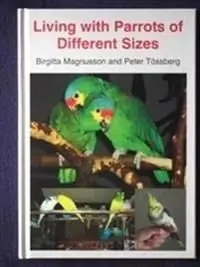
This book is a collection of entertaining stories about Peter Tössberg and Birgitta Magnusson´s own birds. It deals with some of the problems and questions which are likely to be encountered when purchasing a parrot or acquiring one second-hand, and the behavioural problems which can be experienced in owning parrots of different sizes. In the book there are unique photographs of flying parrots (mainly Amazons, Cockatiels and Budgerigars) and also photographs of cockatiel and budgerigar chicks, showing their development from egg to fledged chick. This book has been written for both beginners and more experienced parrot owners, with the purpose of contributing to a better relationship between them and their parrots. The book also gives tips and advice about parrot care which the authors have found to be important, and it is richly illustrated with more than 290 beautiful colour photographs, including photographs of 30 different parrot species. The authors have kept budgerigars, cockatiels and Amazon parrots as pets for many years, and their natural interest in the behaviour of birds and their interaction with humans has become a focus of their lives. Over the past seven years, the authors have published several articles about their budgerigars, cockatiels and Amazons in several major international bird magazines, such as Parrots and Australian BirdKeeper. These articles have been read by people interested in birds in more than 60 countries around the world. Editorial consultant for the English translation: Gilly Lloyd, former editor of Parrots Magazine and of PI Press, the online magazine of Parrots International. Den engelska utgåvan har recenserats av en av världens främsta experter på papegojor, Rosemary Low. Hon har själv skrivit ett 30-tal böcker om papegojor som givits ut världen över på ett flertal olika språk. Även Dorothy Schwarz är känd världen över som specialist på tamfåglar och skriver artiklar för flera ledande papegojtidningar. Båda recensionerna har publicerats i ett flertal världsledande fågelmagasin som Watchbird, Parrots Magazine, Parrot Society Magazine, Cage & Aviary Birds med flera. Recensionerna kan läsas nedan. Living with Parrots of Different Sizes Book review by Rosemary Low ”I only reached page 10 before I heard myself saying Congratulations! out loud! When the authors of Living with Parrots of Different Sizes decided to buy two Amazons as pets, they weighed up the pros and cons of parent-reared and hand-reared young. They decided on parent-reared. The young Red-lored Amazons were six months old and straight out of their parents´ aviary, yet after six and ten days they were taking seed from their fingers and after 16 days the male was sitting on the hand. They soon proved to be easy to train and to handle. The Swedish authors, Birgitta Magnusson and Peter Tossberg, had kept Budgerigars and Cockatiels for some years before deciding on larger parrots. The book describes their experiences with their birds in a most appealing way. It is also full of practical information. Advice is given on important decisions that many parrot owners must take. They debated on whether to take on a second-hand Amazon, in this case a Blue-fronted named Morty, eleven years old and captive-bred. The previous owner was on the point of having him euthanised due to his aggressive behaviour. They decided to give him a chance although several previous rehoming attempts had ended after seven days at the most. Morty proved to be unpredictable, attacking and biting quicker than a cobra. They were both badly bitten. Despite some serious injuries they persevered and suddenly Morty fell in love with Birgitta and became totally devoted to her. I like this book a lot because it describes problems that many parrot owners face, and how they were successfully overcome. Problems with the re-homed Amazons included screaming and biting. A Cockatiel that had had at least five previous homes was stressed and aggressive on arrival but proved to be a very special and lovable bird. Some of their observations, with which I totally agree, are rarely published elsewhere. For example, the authors felt it was important to show her dead mate to a Cockatiel, so that she could understand he had gone. Otherwise she might scream for a long time, not knowing where he was. The authors ask: How many veterinarians are aware of this? The section on Budgerigars as pets is outstanding. Their huge popularity of the 1950s and 1960s declined when larger parrots became available. Like the authors, I have always maintained that they are perfect pets, being intelligent, charming and easy to manage. It was interesting to read that under Swedish law, Budgerigars must live with at least one of their parents for the first six weeks of their lives, to ensure that they are fed properly. The photographs by Peter Tossberg (one or more to a page) are superb. He took an incredible 40,000 shots to achieve the desired results. Those of the Blue-front in flight show the full beauty of this Amazon. And all their birds are in such perfect feather condition that the photos alone are worth the price of the book. Cockatiel and Budgerigar owners will enjoy the enchanting photos of chicks at different stages of their development and of adults in flight. I would describe this as a book of extremely useful and very readable reminiscences, and can recommend it unreservedly.” Living with Parrots of Different Sizes Birgitta Magnusson and Peter Tössberg Reviewed by Dorothy Schwarz ”A parrot book with a helpful difference. Many manuals arrive bulging with instruction. In Living with Parrots … theory and instruction are kept to a minimum and the actual stories of the authors’ named birds remain at the forefront. The authors’ thinking is very much in line with current ideas of positive reinforcement and behaviour science that enlightened owners are keen to pursue. Two other attributes are noteworthy; the authors began with, and still keep, cockatiels and budgies. The intelligence and adaptability of these small birds is often overlooked in favour of their larger cousins. For Birgitta and Peter each bird embodies a personality in its own right and is described as such. With small birds like budgies they consider that a small flock fits in better with the birds’ wild nature of true flock birds. One of their pairs breeds and we are shown how the chicks, although parent reared, are accustomed to the human hand at a young age. Two trends are altering our attitudes towards pet birds. One is for owners to understand the science behind positive reinforcement training. The other idea concerns husbandry – the growing belief that parent reared birds, once hand tamed, are less likely to develop problems in maturity though being confused about their own avian identity. Once Birgitta and Peter had decided they wished to add parrots to their household, they chose, after careful deliberation, a pair of non-related, parent reared red-lored Amazons (Amazona autumnalis autumnalis). It took them only one month to turn these unhandled 6 month old aviary birds into pets. They used positive reinforcement training and sunflower seeds as treat/reward. Another success carefully described is how the pair took on two rescue Amazons, not both at the same time and how they rehabilitated both birds. The first male Morty, relinquished for aggression and the female Filippa for similar reasons. The authors believe that with hard work, time and engagement, it is not impossible to correct problems; it is only a matter of analysing them. Controversy exists about how to fit captive birds into our lifestyle with benefit to both sides. This small book is packed with hands on information on how it can be done. One aspect which convinces me that Birgitta and Peter mean what they write is the evidence of the 290 photographs which illustrate the text. The book is worth having for these pictures alone. I warmly recommend it. The book is obtainable via www.bokus.com”